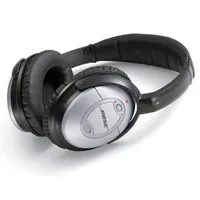
I know what to do. You sit in seat 14B, put on your headphones and you’re ready to immerse yourself in the album. After this, the engine starts. The low, throbbing drone of an airplane swallows up your music. It doesn’t matter if you’re streaming lossless FLAC or just playing low-bitrate MP3 files. The ambient noise level is too high.
This is where active noise-canceling headphones stop being a luxury trick and become a must-have accessory.
The passive limit
First, I’d like to clarify that all headphones have some noise canceling capability. This is called passive damping. Physical materials such as plastic, foam and leather block sound waves. High frequencies are easier to stop. A good seal around the ears can be very helpful.
The best passive design is over the ear. It covers the entire ear instead of sitting on top of the ear. Inside the ear cups is a dense layer of sound-absorbing foam. This adds weight. It adds bulk. After 3 hours, the neck may be tense. However, it can be reduced by about 15-20 decibels (dB).
Here’s the problem. At cruising altitude, the cabin noise for commercial passengers is 75-80 decibels. Passive isolation handles the hiss and the chatter. It struggles with the engine drone. You’re still fighting an uphill battle with physics.
The active solution
Active noise canceling (ANC) headphones do more than just mask sound. They add an electronic layer of defense. Its design still passively blocks high frequencies, but actively cancels low frequencies.
how? By creating your own sound waves.
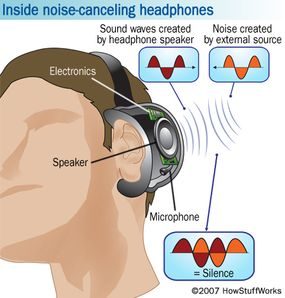
Headphones use built-in microphones to “listen” to ambient noise. Analyze incoming audio profiles in real time. The drivers of the ear cups then create a new wave that mimics noise in all but one important way. So the phase is 180 degrees different.
Destructive interference explained
Think of sound waves as ripples in water. Some ripples push up (crests). Others pull down (troughs).
When the surrounding noise waves are pushed upwards, the sound waves produced by the headphones are also pushed downwards with the same force. Mountains and valleys meet. The compression meets the rarefaction. They collide and cancel each other out.
This phenomenon is called destructive interference.
The result is not just quieter. This is silence. Or close to it. Listeners can only hear the audio they choose. No more engine roar. No more crying babies. Just music.
Why this matters
Passive isolation is protection. Active noise reduction is an eraser.
For frequent travelers, the difference between 20 dB and 40+ dB of attenuation can mean the difference between a stressful commute and a peaceful commute. You can also listen to it at a lower volume. This will protect your hearing in the long run. You don’t need to add bass to compete with jet engines.
Active systems are not perfect. They suffer from sudden sharp noises such as coughing or slamming doors. They need strength. Battery life is a factor. But what about the constant low-frequency hum? They are unique.
The technology has continued to develop since its early days. Modern algorithms can predict noise patterns instead of just reacting to them. Lower latency. Better weight distribution. But the basic principles remain the same. create a wave that negates the world outside.
This is not magic. This is an application of wave physics to household appliances. This is the only way for those who value their sanity (and eardrums) in a noisy environment.
What happens when the battery dies? Active functions are stopped. What remains is a passive seal. It’s better than nothing. But it’s not as quiet as it was five hours ago.
The hardware behind the silence
Active noise cancellation is not magic. This is a special chain of hardware that works synchronously.
First, you need a microphone. They sit inside the ear cups and listen to external sounds that passive isolation cannot block.
Next is the circuit. These electronic devices take the microphone input and map the noise fingerprint. They look at the frequency and amplitude of the incoming sound waves. Next, create a new wave with a phase difference of 180 degrees. This is an anti-sound.
The speaker does the rest. Play counter sounds next to the actual music. Antisound suppresses noise through destructive interference. It won’t affect the sound you want.
Finally, there is the battery. This makes the system “active”. Energy must be added to produce cancellation. This energy comes from a rechargeable battery.
With this setting, noise canceling headset can reduce noise by an additional 20 decibels. This blocks out about 70% of ambient sounds. This result is ideal for airplanes, trains or open-plan offices where ambient noise is constant.
Compromise
This technique is great for separating the sound you want from the noise you don’t. But it’s not perfect.
Some users reported that the sound quality was muffled. The silence feels unnatural. You may also notice changes in the air pressure in your ears. Manufacturers try to solve this problem by removing trapped air through holes in the ear cups.
Despite these problems, many people still refuse to use regular headset. The benefits are more than just silence. Exposure to low-frequency noise can cause fatigue. Canceling will reduce this feeling of fatigue.
You don’t even have to play music. You can use them to silence the world. Often, all you need is a little quiet.
Learn about decibels and hardware
To understand the ratios, you need to look at decibels (dB). Measure the volume of the sound. The scale is logarithmic. An increase of 10 dB makes the sound 10 times louder. A sound of 30 dB is 10 times louder than a sound of 20 dB.
There are also differences in the hardware. Headphones with a small microphone are called headset. Microphones and speakers are both transducers. Microphones convert sound waves into electrical signals. Speakers are the opposite.
Frequently asked questions about noise reduction technology
Do noise canceling headset block sound?
Although it can reduce ambient noise, it doesn’t block people’s voices.
What are the best headset for sleeping?
Noise-cancelling earplugs or in-ear headset are required. These can drown out street noise, your neighbor’s music and your partner’s snoring. Bose Sleepbuds II are designed for sleeping and have an alarm clock.
Is noise cancellation technology bad for you?
No. These headset do not emit radiation and do not pose a health risk to you or others around you.
What are the cheapest noise canceling headset?
“Cheap” is relative. Even mid-priced options are expensive. If you have a budget of around $80 on Amazon, the Anker SoundCore Life Q30 or the TaoTronics SoundLiberty 94 True Wireless are great options.
Overall, what are the best noise canceling headset?
Bose invented this technology and is still a strong contender. However, Sony WH-1000XM4, Bose 700s and Apple AirPods Max are also important choices on the market.