
Navigation apps are like a trusted co-pilot. Describe the course. You can avoid traffic jams. It promises to take you home. But what happens when that trust is weaponized?
Researchers at the Ruhr University Bochum are investigating the frightening reality. This is not a fault. This is hacking.
Imagine that you are sitting in a stopped car. The engine is off. Enter your destination. Suddenly the screen comes alive. A blue arrow representing your current location will begin to slide on the map. The app thinks you’re traveling 60 miles per hour. you are not. you are frozen GPS signal has been spoofed.
Or consider the drive itself. You follow the turn. Trust voice commands. However, the destination is not an application-defined location. You are dropped in a completely different place.
This is GPS spoofing. This is not science fiction. It’s happening now. The security implications are serious.
Mechanism of fraud
How does this work? The main problem is the nature of GPS signals. By the time they arrived on Earth, they were already greatly weakened. A standard GPS receiver can track signals from satellites 20,000 kilometers away. The received power is less than that of a lightbulb seen from space.
Hackers use a technique called “spoofing” to exploit this weakness. Unlike jamming, which simply blocks the signal and renders the GPS useless, spoofing involves sending a false signal. These signals are stronger than actual satellite signals.
The receiver is designed to ignore real satellites and lock onto the strongest signal source. It attaches itself to the fake signal.
The result? A fabricated reality.
The navigation system displays a location that doesn’t exist. Calculate the route based on the wrong coordinates. In the scenario studied by the Bochum researchers, users might be sitting still while the app claims to be driving on the highway. The discrepancy is visually jarring. The speedometer lied. The map is moving. The car does not.
Why This Matters Beyond Convenience
We often think of GPS as an aid. Find a restaurant or avoid traffic. But it is foundational infrastructure.
If navigation devices can be fooled, so can more critical systems.
- Logistics: Trucks carrying valuable cargo can be rerouted.
- Emergency services: Ambulances can be delayed or led away from their destination.
- Personal Safety: As Bochum research reveals, you may be taken to remote areas. It’s not just about being late. It’s about vulnerability.
“We trust Navis blindly. But when our data is compromised, the trust becomes a liability.”
In Bochum, researchers are investigating how these attacks work. They study the properties of signals. They recognize patterns that distinguish genuine satellite signals from fake ones.
Recognize the invisible
The challenge for users is that the purpose of the fraud is to make it look real. The user interface remains unchanged. Voice commands remain calm and authoritative. There is no warning light that says “GPS Compromised.”
Detection requires looking deeper than the screen.
Researchers are looking for ways to identify the differences. Problems can occur if the shape of the satellite does not match its reported position. if
Why your car’s GPS lies
This seems like a simple glitch. Route recalculation. I turned left when I should have turned right. But this is not a bad signal or a software bug. It is a hack. GPS is much more fragile than most drivers realize.
Hackers don’t need to break into satellites. They use a simulator. The signal produced by the device cannot be distinguished from the real signal. It broadcasts them directly to receivers. Your car’s navigation system is receiving incorrect information. It believes it is somewhere else entirely.
Christina Pöpper from Ruhr-University Bochum clearly explains the mechanism. The attacker convinces the receiver into believing they are in another location. This is not a theoretical matter. It’s happening now.
The stakes are high. This is not just about getting lost. Advanced deception allows criminals to hijack vehicles. Trucks. Ships. Even fully loaded cargo can be hijacked and looted. The deception is complete. The system trusts this signal. The signal is a lie.
In industrial environments, the risks are even more serious. GPS synchronizes machines. It keeps production lines ticking in perfect time. A spoofed signal disrupts this timing. As a result, a halted factory floor. Downtime costs money. Chaos follows.
The US Navy is well aware of this danger. They no longer rely solely on GPS. They now teach their cadets about celestial navigation. You read the sextant. You look at the stars This is an ancient skill. It is becoming necessary again.
Pöpper points out that GPS vulnerabilities have been known since 2002. That’s more than 20 years ago. Since then, many countermeasures have been proposed. Nothing offers perfect protection. Every solution has limitations. The defense depends entirely on the strength of the attacker.
How strong is the person trying to fool you? This remains an open question.
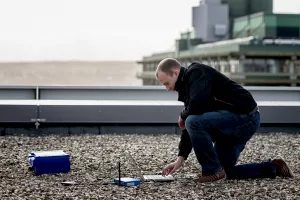
Multi-antenna spoofing detection
Protecting navigation systems from spoofing attacks requires a shift in perspective. Instead of relying on a single data point, the defense strategy relies on redundancy. Christina Pöpper and her colleague Kai Jansen are developing a solution based on a simple principle: duplicate the hardware. By installing multiple GPS receivers with physical separation, it becomes significantly harder for an attacker to fool the entire system simultaneously.
The logic is straightforward. Real satellites orbit the Earth at distinct locations. When a vehicle receives signals from these true sources, the timing and angle of arrival vary slightly between two separate antennas. The calculated positions will differ, albeit within a small margin of error. Spoofing breaks this geometry. An attacker uses a simulator to broadcast fake signals. These signals are uniform. They look identical to every receiver in the vicinity. If both antennas are being fed the same lie, they calculate the exact same false position. The discrepancy that reveals the truth disappears.
The detection mechanism hinges on this inconsistency. If two receivers are close enough to be spoofed by a single local transmitter, they will agree on the fake location. If they are far enough apart, the natural variation of real satellite signals creates a detectable variance. The spoofing signal, being artificial and centralized, cannot easily replicate the complex spatial geometry of the real sky for both sensors at once. It forces them into a false consensus.
Hardware constraints and minimum spacing
“We have already demonstrated that this method works for detection,” says Pöpper. “Currently, we are refining the specifics.” The primary challenge is determining the minimum distance required between receivers. This distance must be large enough to account for inherent measurement inaccuracies in real-world conditions. If the receivers are too close, natural noise might mask the spoofing attempt, or worse, cause false positives due to minor positioning drifts.
Current research indicates a minimum separation of two to three meters. Below this threshold, the error rate rises. The system struggles to distinguish between legitimate signal variance and the lack of variance caused by spoofing. This constraint dictates where the technology can be deployed effectively.
“This can be easily realized in large vehicles or machines like trucks or ships, as it is possible to position the receivers far enough apart.”
Heavy machinery offers an advantage here. Trucks and ships have ample physical space. Engineers can mount antennas at opposite ends of the chassis or hull. This maximizes the baseline distance, improving the accuracy of the triangulation and making spoofing attacks far more difficult to execute successfully.
The smartphone problem
The solution works brilliantly for large assets. It falls flat for consumer devices. Smartphones are small. Internal antennas are packed tightly together. There is no room for a two-meter separation. This leaves mobile users vulnerable. Pöpper’s team acknowledges this limitation. They are actively working on solutions for spatially constrained devices.
For now, the technology is suited for fleet management, industrial automation, and maritime navigation. It is not yet ready for the average commuter. The gap between theoretical security and practical consumer application remains wide. Until the algorithms can compensate for tiny antenna spacing without drowning in noise, phones will remain susceptible to localized signal manipulation. The hardware reality limits the software fix.