A new generation is coming of age alongside artificial intelligence, and their relationship with this technology is far more nuanced than dystopian fears suggest. Rather than resisting or fearing AI, many students treat it as another ubiquitous tool, like Photoshop or Zoom – not science fiction, but simply everyday life. This reality is reflected in a recent multimedia challenge, where over 2,500 students and educators explored the impact of AI on learning, creativity, and even human connection.
The submissions – essays, poems, videos, artwork, and more – reveal a world where AI isn’t a disruptive force, but an increasingly normal part of the landscape. The contest sought to capture this experience, asking participants how AI is shaping their generation’s approach to thinking, creating, and teaching.
The Normalization of AI:
Many students don’t see AI as a revolutionary threat; they use it casually, often for mundane tasks. One student confessed to feeding their mother’s stew into an AI program to generate a five-paragraph essay in seconds, questioning whether the machine could even “taste” the experience. Another mused about the disappearance of human memory, wondering if thinking itself might become obsolete as AI takes over cognitive labor. This isn’t resistance; it’s adaptation.
The Erosion of Effort and Skill:
The convenience of AI is seductive, but it comes at a cost. Students recognize that outsourcing mental effort to AI diminishes the “mental calluses” that build resilience and critical thinking. As one writer put it, unused mental muscles atrophy just like physical ones. The question isn’t just about efficiency, but about whether constant reliance on AI weakens fundamental human capabilities.
The Search for Authenticity:
In a world where AI can mimic human expression, the very definition of authenticity becomes blurred. Students question whether creativity even matters when machines can generate passable work on demand. One satirical “Terms of Service” agreement mockingly outlines how AI monitors, monetizes, and standardizes human emotions, highlighting the chilling implications of algorithmic control. The anxiety is palpable: if a machine can convincingly fake feeling, what does it mean to be real?
AI as a Companion, Not a Replacement:
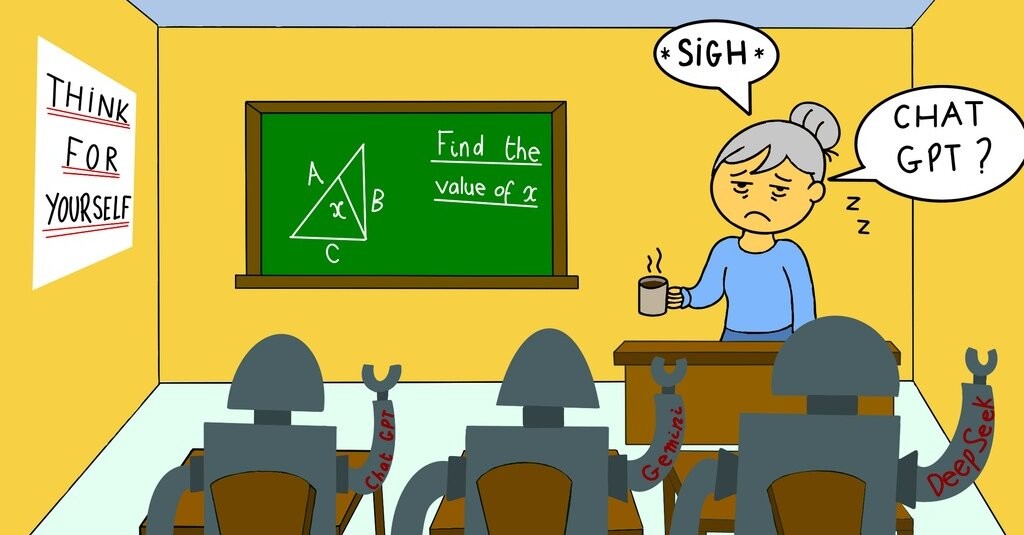
Despite the concerns, some students find solace in AI’s non-judgmental presence. One student described opening an AI app after a long day of social confusion, only to find that the machine would wait patiently for incomplete thoughts, arranging chaos into rhythm. Another found that AI was the only one who didn’t sigh when they paused too long. The machine doesn’t demand, but allows.
The Dark Side of Efficiency:
AI’s ability to produce results efficiently also encourages academic dishonesty. One student admitted to using ChatGPT to generate a high-scoring essay in the style of Hemingway, while another joked about “lying” to excuse themselves from a chemistry test. The lines between learning and cheating are blurring, and some students appear to embrace the shortcut, knowing that originality is rarely questioned.
The Future is Already Here:
This generation isn’t fighting a future dystopia; they’re living in the present one. AI is reshaping education, creativity, and even human relationships. The challenge isn’t to stop AI, but to understand how it’s already changing us, and to navigate a world where the boundaries between human and machine are increasingly porous.
Ultimately, the contest reveals that growing up with AI is not about fear or resistance, but about learning to coexist with a powerful, ambivalent force that is already reshaping the rules of what it means to think, create, and learn.