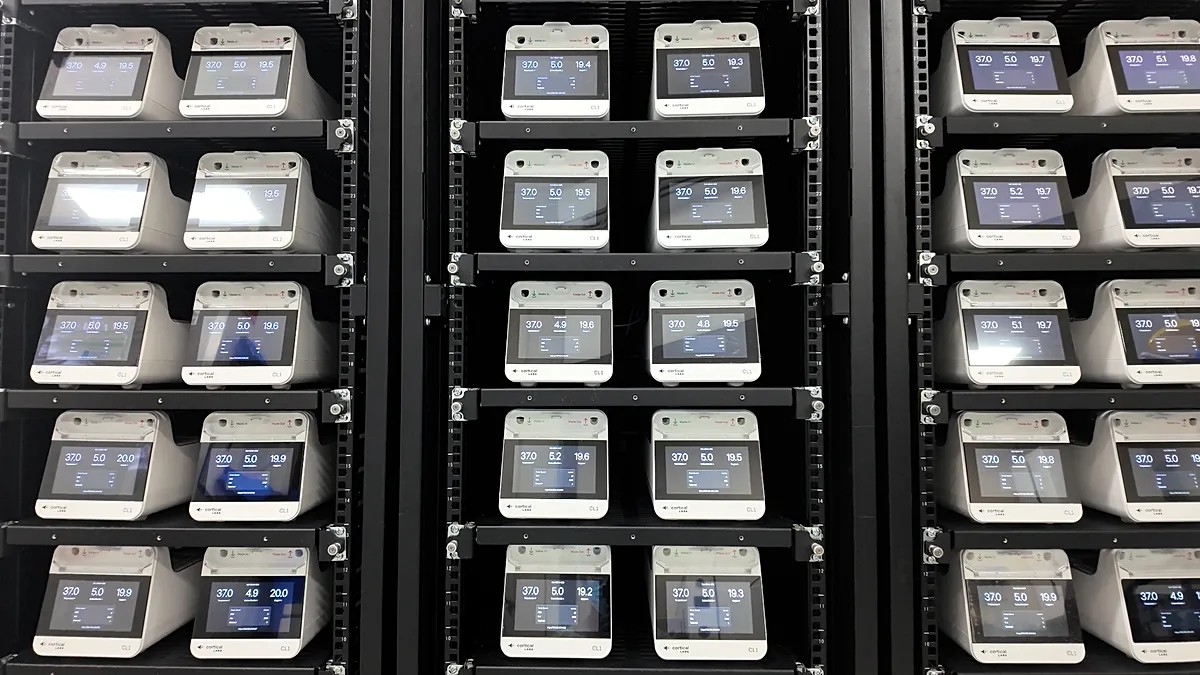
An Australian startup, Cortical Labs, has achieved a breakthrough in biological computing, creating the first system capable of running code on living human neurons. This innovation comes as global demand for data centers—fueled by artificial intelligence (AI)—soars, and researchers seek more efficient and adaptable computing solutions. The company’s CL1 system integrates lab-grown neurons with silicon hardware, opening doors to applications in neuroscience, disease modeling, robotics, and AI itself.
How It Works: Bridging Biology and Silicon
The CL1 operates by growing neurons from stem cells and placing them on microchips equipped with electrodes. These electrodes send electrical signals to the neurons and interpret their responses, effectively turning the cells into a biological processor. While still utilizing silicon chips, this system differs fundamentally from traditional computers by employing “wetware”—living cell cultures sustained by nutrient-rich liquid. Cortical Labs has already deployed 120 such units in a small data center in Melbourne, Australia.
The key difference is not simply having neurons in a lab (which has been done before), but standardizing the process. The company claims to have reduced setup time from months or years of specialized lab work to just hours or days, making biological computing far more accessible.
Why This Matters: Efficiency and Adaptability
Human biology offers unique advantages over silicon. Neurons are exceptionally energy-efficient, requiring far less data to learn compared to conventional machine learning. As Cortical Labs’ chief scientific officer, Brett J. Kagan, points out, “Biology is incredibly energy efficient… [humans] don’t require huge amounts of data.” The system also exhibits adaptability, handling uncertainty and noisy information more effectively than rigid silicon systems.
Beyond efficiency, the use of human-derived cells allows for personalized research. Grown from donor samples, the neurons may reflect specific genetic traits, enabling scientists to study cellular responses to treatments in a controlled environment. However, Kagan acknowledges that traditional silicon chips remain superior for precise, high-speed mathematical calculations.
The Future of Computing: Hybrid Systems
The long-term vision is not to replace silicon but to integrate it with biological components. Advances in current AI systems are hitting practical limits, demanding ever-increasing data and processing power. A hybrid approach could unlock capabilities that neither biology nor silicon can achieve alone.
This perspective is shared by some experts, who recognize the potential of biological systems but question current limitations. Alysson R. Muotri, director of the Sanford Stem Cell Education Center, notes that flat neuron networks may not offer significant advantages over silicon, but more complex, three-dimensional structures (organoids) could hold greater promise.
Ethical Implications: Consciousness and Oversight
The integration of human cells into computing raises ethical concerns. While simpler neuron networks may not pose immediate risks, more complex brain-like structures could potentially generate some form of consciousness, sparking debate over moral boundaries. Muotri suggests this might necessitate new regulations and oversight as the technology matures.
Cortical Labs argues its approach could offer ethical benefits, reducing animal testing and providing greater control over biological systems. The company’s co-founder believes leveraging all available tools is the key to optimal results.
The future of computing is when we can leverage all of the tools that we have available to get the best result.
The emergence of ‘wetware’ computing marks a pivotal shift in how we approach computation, blending the precision of silicon with the adaptability and efficiency of living biology.