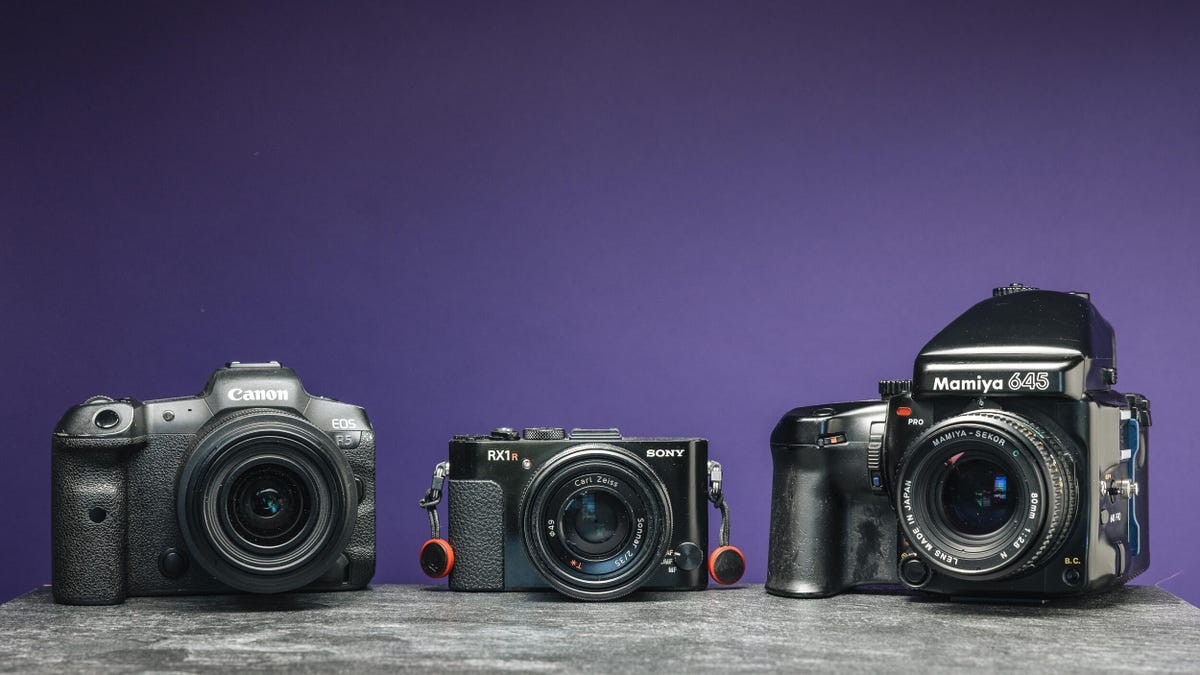
Professional photographers rely on different tools for different jobs. After years working in editorial, product, landscape, travel, and street photography, it’s clear that there are three fundamental types of camera every photographer should have access to. This isn’t about brands (Sony, Canon) or sensors (full-frame, APS-C) but about how cameras approach the craft. A versatile setup can be achieved with two cameras, or even just one, if it meets the criteria.
The Workhorse: Reliability and Speed
Every photographer needs a primary “workhorse” camera. This is the tool you grab for paid shoots, demanding assignments, or any situation where consistency matters. It’s fast, dependable, and equipped with interchangeable lenses, often with image stabilization and high-speed autofocus. Modern technology is key.
For many professionals, this might be a Canon R5, Sony A7RV, Nikon Z8, or Panasonic Lumix S5II. The exact model isn’t the point; it’s the ability to deliver high-quality results under pressure. Whether launched in 2005 or 2025, the workhorse is the camera you trust to perform every time. It’s typically larger and more expensive, but essential for professional reliability.
The Everyday Carry: Simplicity and Accessibility
To capture life’s spontaneous moments, photographers need a secondary “everyday carry” camera. This is a smaller, simpler option – often a compact point-and-shoot with a fixed lens like the Fujifilm X100VI or Ricoh GRIII. It’s the camera you take everywhere: camping, traveling, or even just to the pub.
The point is accessibility. This camera avoids the burden of multiple lenses and allows for quick, casual shooting without hesitation. It might even be your phone, but a dedicated compact camera offers better image quality and a more deliberate shooting experience. It’s the camera for social moments, casual snapshots, and capturing memories without fuss.
The Artful One: Inspiration and Slow Craftsmanship
Finally, every photographer needs a camera that inspires. This isn’t necessarily the most technically advanced or versatile tool. It’s the one that makes you slow down, think critically, and focus on artistic expression. It could be a film camera (35mm or medium format), forcing deliberate choices and a methodical approach. Or it might be a digital medium format camera like the Fujifilm GFX or Hasselblad 907X 100C.
The key is that this camera should motivate creativity, even if it’s challenging to use. It’s the tool responsible for your proudest work, pushing you to experiment and refine your vision. It may not be the first camera you reach for, but it will be the one that ultimately elevates your artistry.
The Bottom Line: A well-rounded photography setup requires a balance of reliability, accessibility, and inspiration. While some cameras can fulfill multiple roles, ensuring each category is covered will unlock your full potential and produce the best possible work.