In the vast landscapes of America’s National Parks, a new kind of inhabitant is taking flight—though it doesn’t breathe. To combat the alarming decline of native species, scientists and park managers are deploying robotic decoys designed to trick real birds into returning to their ancestral homes.
The “Frankenbird” Experiment
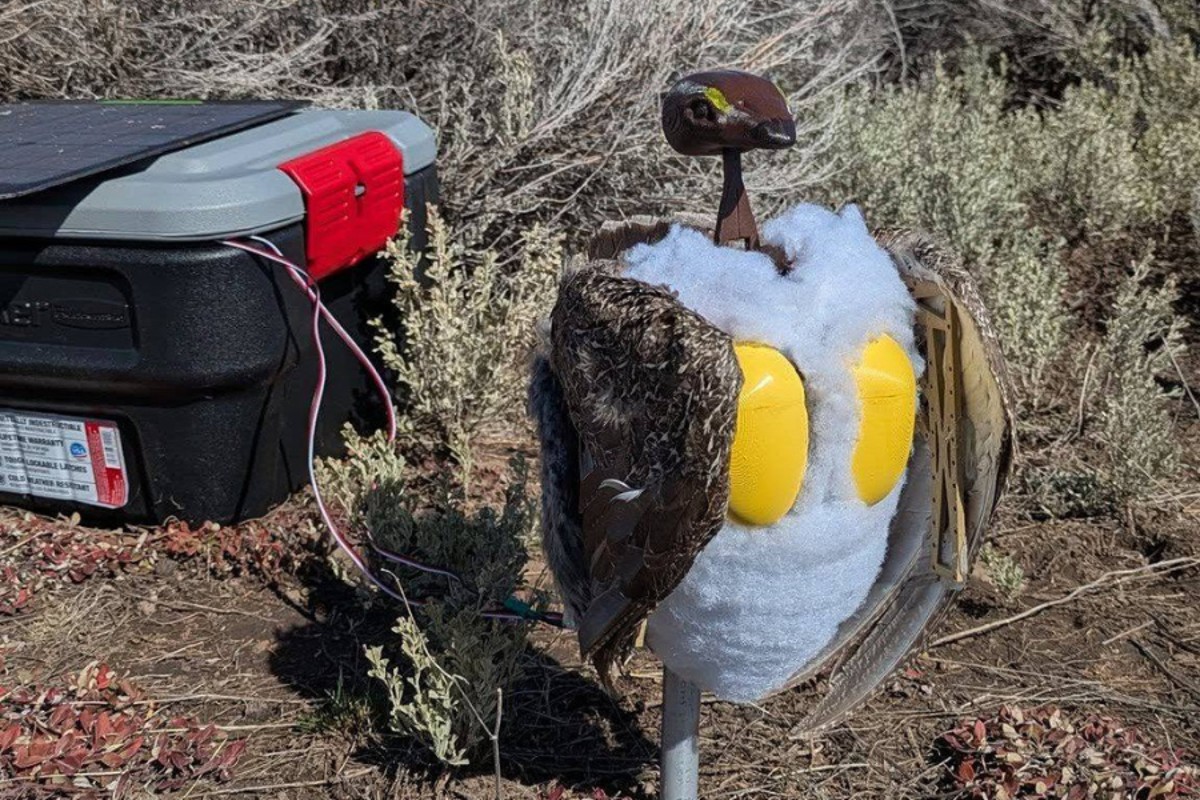
At Grand Teton National Park in Wyoming, a unique conservation project is currently testing the effectiveness of “robo-grouse.” These machines are far from polished high-tech drones; rather, they are a blend of engineering and improvisation.
Developed with the help of local high school students and robotics mentor Gary Duquette, these decoys—sometimes referred to as “Frankenbirds” —utilize a mix of authentic and recycled materials. To ensure realism, the team uses actual feathers provided by the Wyoming Game and Fish Department, combined with unconventional components like foam from meal kits and fabric from retail stores.
Despite their makeshift appearance, their function is highly specialized. The robots are programmed to replicate the complex courtship rituals of the sage grouse, performing synchronized movements and wing displays paired with recorded mating calls to simulate a vibrant, active breeding ground.
Why This Matters: The Sage Grouse Crisis
The deployment of these robots isn’t just a scientific curiosity; it is a response to a biological emergency. The sage grouse has faced a catastrophic decline, with populations across the American West dropping by approximately 80% since 1965.
The scale of this loss is starkly visible in Jackson Hole:
– 1950: 73 male sage grouse recorded at a single breeding site.
– Last year: Only 3 males remained at that same site.
This decline is primarily driven by habitat fragmentation and degradation. Decades of cattle grazing stripped the sagebrush flats of the food and cover necessary for survival. While restoration efforts have since removed grazing from these areas, “re-wilding” a landscape is rarely a linear process. As park spokesperson Emily Davis noted, even when a perfect habitat is restored, wildlife does not always return immediately.
Overcoming Environmental Hurdles
Restoration is a multi-front battle involving both land management and human infrastructure. Beyond habitat loss, the sage grouse faces physical threats from local industry.
The Jackson Hole Airport, uniquely situated inside a national park, poses a significant risk to avian life. Between 1990 and 2013, 32 birds were killed in aircraft-related incidents. To address this, officials have worked to restore roughly 100 acres of land south of the runways, creating open breeding grounds that balance the needs of the birds with the operational requirements of the airport.
The Goal: A Biological Jumpstart
The current objective is to use these robotic displays to “jumpstart” activity in restored areas. If the decoys can successfully lure male grouse to these sites, the resulting courtship and nesting could lead to a new generation of chicks being raised in a safe, protected environment.
Researchers are currently using trail cameras to monitor the lek sites through the end of the breeding season in mid-May. They are looking for one specific sign of success: do the real birds respond to the mechanical dancers?
If these robotic decoys successfully trigger a return of the sage grouse, this technology could provide a blueprint for managing wildlife populations in other national parks facing similar ecological collapses.
Conclusion
By blending robotics with traditional conservation, park officials are testing whether artificial signals can trigger real biological recovery. The success of these “Frankenbirds” could determine whether declining species like the sage grouse can reclaim their lost habitats or continue their slide toward extinction.