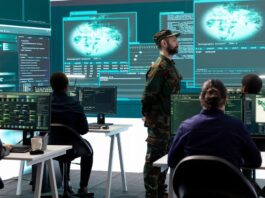
The scale of modern warfare is undergoing a fundamental shift, moving from a human-paced process to one governed by algorithmic speed. During recent operations against Iran, the US military struck more than 1,000 targets in a single 24-hour period—nearly doubling the intensity of the “shock and awe” campaign used in Iraq two decades ago.
This acceleration is not merely a result of more weapons, but of a digital revolution in the “kill chain.” At the heart of this transformation is Project Maven, a system that is rapidly evolving from a niche intelligence experiment into the backbone of US and NATO targeting capabilities.
From Drone Footage to “White Dots” on a Map
Project Maven began in 2017 as an effort to use computer vision to sift through massive amounts of drone footage. Previously, human analysts could only process a tiny fraction—sometimes as little as 4%—of the data collected by drones. The goal was to use AI to act as a “second set of eyes,” identifying objects and patterns that humans might miss.
The project’s evolution was driven by Colonel Drew Cukor, a Marine intelligence officer who sought to solve a chronic problem: the fragmented, “analog” nature of military intelligence. In past conflicts like Afghanistan, critical data was often trapped in static formats like Excel sheets and PowerPoint presentations, making it difficult for frontline operators to access real-time intelligence.
Cukor envisioned a more seamless interface—what he called “white dots” on a map. These would be intelligent coordinates that provided not just a location, but elevation, identity, and real-time status. This vision transformed Maven from a simple analysis tool into a comprehensive workflow management system.
The Rise of the AI Kill Chain
The integration of AI has dramatically compressed the time required to move from identifying a target to executing a strike. This process, known as the “kill chain,” traditionally involved multiple human steps: data collection, assessment, decision-making, communication, and execution.
With the Maven Smart System, the role of the human has been drastically reduced:
– Automation of Assessment: AI now handles much of the data synthesis, including satellite imagery, radar, and social media.
– Integration of LLMs: Large Language Models (LLMs), such as Anthropic’s Claude, are being used to process information and speed up reporting.
– Reduced Human Oversight: While the military maintains that humans still make the final decision to strike, the “middle” steps—the assessments and communications—are increasingly handled by machines.
“A process that once took hours can now be completed in seconds,” according to military officials.
This speed allows the US to scale its operations exponentially. While the military could previously hit roughly 100 targets a day, AI-enabled systems have pushed that number to 1,000, with the potential to reach 5,000 as LLMs are further integrated.
The Danger of Algorithmic Speed
While proponents argue that AI increases precision and reduces human error, the rapid acceleration of targeting raises profound ethical and operational risks. The speed at which these systems operate may leave little room for the “deliberation” necessary to catch errors.
A recent strike on an Iranian school, which resulted in the deaths of over 150 people (mostly children), serves as a grim case study. While much of the initial debate focused on whether AI “hallucinated” the target, technology historians argue the deeper issue is the acceleration itself. If a database contains an error—such as a school being mislabeled as a military site—an AI system can process that error and present it as a high-confidence target far faster than a human could verify it.
Key risks identified include:
* Data Integrity: An automated system is only as accurate as its underlying database. If the data is wrong, the AI will simply execute a mistake more efficiently.
* The “Gamification” of War: Military ethicists warn that highly polished user interfaces may lead operators to trust AI-generated targets blindly, treating lethal decisions like a digital interface rather than a high-stakes human event.
* Loss of Strategic Deliberation: As retired Defense Secretary Jim Mattis has noted, high-speed targeting is not a substitute for strategy. Hitting more targets more quickly does not necessarily equate to winning a conflict.
A New Era of Warfare
The transition of Project Maven into a “program of record” signals that the US military is fully committing to an AI-driven future. From testing algorithms in the snow of Ukraine to deploying automated surveillance, the march toward autonomous warfare is well underway.
Conclusion: As the US military integrates AI into the core of its targeting cycles, the primary challenge shifts from technological capability to data accountability. The speed of the machine may offer unprecedented efficiency, but it also risks turning human errors into rapid, large-scale tragedies.