
Your laptop isn’t sleeping. It’s dreaming.
While you’re catching up on Zs, millions of servers are busy reinterpreting old data and spitting out weird, new material. The engine behind this digital lucid dreaming is Google Deep Dream. It’s a program designed to find patterns in images and then twist them into something unrecognizable.
You upload a picture. The algorithm hunts for features it recognizes. It amplifies them until they take over. The result ranges from silly to artistic to outright nightmare fuel.
Why Deep Dream Matters
This isn’t just a party trick. It’s a window into how machines see. By making these tools public, Google aimed to understand how its systems classify and index visual data. You can try it yourself. Upload a photo of your dog. Seconds later, you’ll get a fantastical, distorted version of that same image.
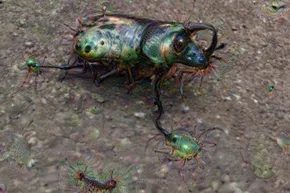
The output looks like Salvador Dali colliding with Hieronymus Bosch, then crashing into Van Gogh’s palette. Leaves become colorful swirls. Mountains turn into repetitive rectangles. Empty landscapes sprout pagodas, cars, bridges, and human body parts.
And animals. Always animals.
Upload a portrait of Tom Cruise. The program doesn’t see an actor. It sees creases and spaces that resemble dog heads, fish scales, and other familiar creatures. But these aren’t normal animals. They’re fantastical recreations, crossed with an LSD-tinged kaleidoscope. They’re eerie. Terrifying.
Google isn’t feeding its servers hallucinogenic chemicals. It’s guiding those racks of silicon to analyze images and regurgitate them as new representations of our world.
Neurons in Bits
How does it work? It speaks to the nature of how we build digital devices. It’s about how machines digest the unimaginable amount of data we dump into the cloud. The process mimics neural networks. Layers of abstraction. The machine looks for edges, then shapes, then objects. Deep Dream forces it to double down on whatever it finds first.
It’s not magic. It’s math. But the output feels alive.
The results are typically a bizarre hybrid digital image that looks like Salvador Dali had a wild all-night painting party with Hieronymus Bosch and Vincent van Gogh.
We spend years trying to make AI look like humans. Deep Dream does the opposite. It makes images look like AI. It exposes the gap between how we see and how code processes light.
The implications go beyond weird art. If a machine can be coaxed into seeing faces in clouds, what else is it seeing that we ignore? What patterns are hiding in plain sight, waiting for the right parameters to reveal themselves?
We don’t know yet. The servers keep working. The images keep changing. The dream continues.


Computers are inorganic. They don’t sleep. They don’t dream. Or so we assumed. Yet Deep Dream stands as a stark, visual contradiction to that logic. It proves just how twisted a computer program can become when it’s forced to digest data from the human world.
The origin story isn’t mystical. It’s bureaucratic. Google’s engineers built the initial framework for the ImageNet Large Scale Visual Recognition Challenge. This annual contest, launched in 2010, pits dozens of organizations against each other. The goal is simple: find the most effective way to automatically detect and classify millions of images. Every year, the developers tweak their methods. They push for better accuracy. They reevaluate.
Why does this matter to you?
Image recognition remains a glaring hole in the standard internet toolkit. Search engines still cling to typed keywords. That’s why you have to manually tag your photo library with “cat,” “house,” or “Tommy.” Computers struggle to look at a picture and understand it. Visual data is messy. It’s cluttered. It defies clean categorization.
Deep Dream changed that trajectory. It helped machines learn to see.
The Architecture of Perception
To make Deep Dream function, programmers deployed an artificial neural network (ANN). This isn’t just a fancy algorithm. It’s a system designed to learn independently.
The architecture mimics the human brain. Your brain uses over 100 billion neurons. These nerve cells transmit impulses that keep your body running. Deep Dream doesn’t have a body. It has layers.
Typically, the network consists of 10 to 30 layers of artificial neurons.
Here is the process:
– Data enters the network.
– Artificial neurons filter this data in myriad ways.
– The process repeats, over and over again.
– The system eventually arrives at a result.
In Deep Dream’s case, the result is an image. But not just any image. It’s a hallucination.
How Deep Dream Warps Reality
You might wonder how a program converts a familiar scene into computer-art renderings that could haunt your nightmares.
The answer lies in what the network values. The neural network was trained to recognize patterns. When it processes an image, it looks for edges, shapes, and textures. Deep Dream amplifies these patterns. It finds what it recognizes and exaggerates it.
It doesn’t just detect a dog. It finds “dog-ness” and injects it into every corner of the photo. A tree branch becomes a furry snout. A shadow becomes a watchful eye. The computer is essentially projecting its internal model of the world onto your photograph.
Computer Brains and Bikes
The parallel between biological and artificial processing is often overstated, but the mechanics are surprisingly similar. Just as a neuron fires based on inputs from others, each layer in the network passes filtered data to the next. The deeper the network, the more abstract the representation.
Early layers might detect simple lines. Later layers detect complex structures. Deep Dream pushes this to the extreme. It doesn’t stop at recognition. It generates. It takes the abstract concepts learned during training and forces them into visual form.
This is how a static image becomes a psychedelic landscape. The computer isn’t dreaming in the human sense. It doesn’t have subconscious desires. It has weights and biases. It has a loss function it’s trying to minimize. But the output? The output looks like a dream.
Neural networks don’t just magically start sorting data. They need training. Without a reference library of examples, the system is blind. It sifts through pixels with no context.
Training relies on repetition. Google’s blog explains the mechanics clearly. If you want an Artificial Neural Network (ANN) to recognize a bicycle, you feed it millions of images. You also code specific rules: two wheels. A seat. Handlebars.
Then you let it run. The results are rarely perfect. The system might flag motorcycles or mopeds as bikes. This is where human intervention kicks in. Programmers tweak the code. They clarify that bicycles lack engines and exhaust pipes. They run the loop again. And again. Fine-tuning continues until the output is acceptable.
The Deep Dream team noticed a shift. Once a network learns to identify objects, it can also recreate them. A system trained on bicycles can generate new bike imagery without fresh input. It classifies, sorts, and then creates.
But the generation process is flawed. Even after analyzing millions of bike photos, the computer makes critical errors. It might attach human hands to handlebars. Or feet to pedals. Why? Because the training data often includes people. The network struggles to separate bike parts from human parts.
These errors occur for many reasons. Even software engineers don’t fully understand every neuron’s behavior. But knowing the architecture helps explain the glitches.
The artificial neurons work in stacks. Deep Dream uses between 10 and 30 layers. Each layer captures different image details. Early layers detect basic borders and edges. Middle layers identify colors and orientation. Other layers search for shapes resembling chairs or light bulbs. The final layers react only to complex objects like cars, leaves, or buildings.
Google’s developers call this architecture inceptionism. They even published a public gallery of Deep Dream’s work to showcase the results.
Once the network isolates various image aspects, the possibilities open up. For Deep Dream, Google directed the network to generate entirely new images from these extracted features.
Darkness on the Edge
The Feedback Loop of Artificial Perception
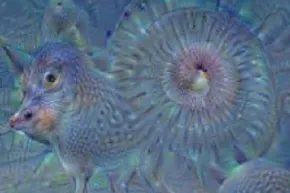
The real trick isn’t just letting the algorithm pick features. It’s making the computer obsess over them. Google’s engineers gave Deep Dream a directive: find patterns and amplify them. If it spots a dog shape in the paisley weave of your sofa, it doesn’t just note it. It exaggerates the snout. It sharpens the ears. It turns a harmless textile print into a canine face.
Each iteration layers on more detail. Fur. Eyes. Teeth. The original image gets buried under the weight of its own detection. You start with a couch. You end up with a dog. Then another dog inside that dog. It’s a recursive zoom, a feedback loop that feeds on itself until the picture transforms into something psychedelic.
Clouds become space grasshoppers. Rainbow cars emerge from static. And there are always dogs. Why? Because the training data included 120 distinct dog subclasses. The network was expertly classified in canine recognition. So when it scans for form, it’s statistically likely to find puppy faces. It’s a bias baked into the code.
Creating Art from Nothing
Deep Dream doesn’t even need a source image. Feed it a white screen. Feed it random noise. It will still hunt for structure. It treats the blank canvas as raw material for meaning. The software tries to impose order on chaos. It looks for edges. It constructs shapes from void.
This reveals the core purpose of the project. It’s not just about weird art. It’s about teaching machines to contextualize the visual data flooding the internet. The goal is better image recognition. Better filtering. Better understanding of what we see online.
Are They Dreaming?
Does the computer dream? Or is it just processing data in a way we find unsettling?
No one is coding specific tasks. The instructions are vague. Find details. Accentuate them. Repeat. The software operates without overt human guidance. The output is a direct reflection of that autonomy.
Are these machine-created artworks? Perhaps. They are manifestations of silicon logic. But they also point toward a future where computers rely less on human input. You might fear sentient machines taking over. Right now, this technology helps you sift through millions of photos faster. It improves search. It enhances visual data processing.
The pace of advancement is accelerating. Thanks to experiments like this, the next leap in image recognition is already underway. We are seeing the early stages of a new kind of intelligence. One that finds patterns we might miss. One that sees dogs in the clouds.
Frequently Answered Questions
What is Operation DeepDream?
Launched by Google in 2015, DeepDream uses a convolutional neural network to enhance patterns in images. It adds layers to the image, creating strange, otherworldly visuals by amplifying features the AI detects.
Is DeepDream generator free?
Yes, the DeepDream generator is free to use.