Weapon-wielding machines. No longer sci-fi. Just waiting around the corner.
The gap between imagination and reality is shrinking fast.
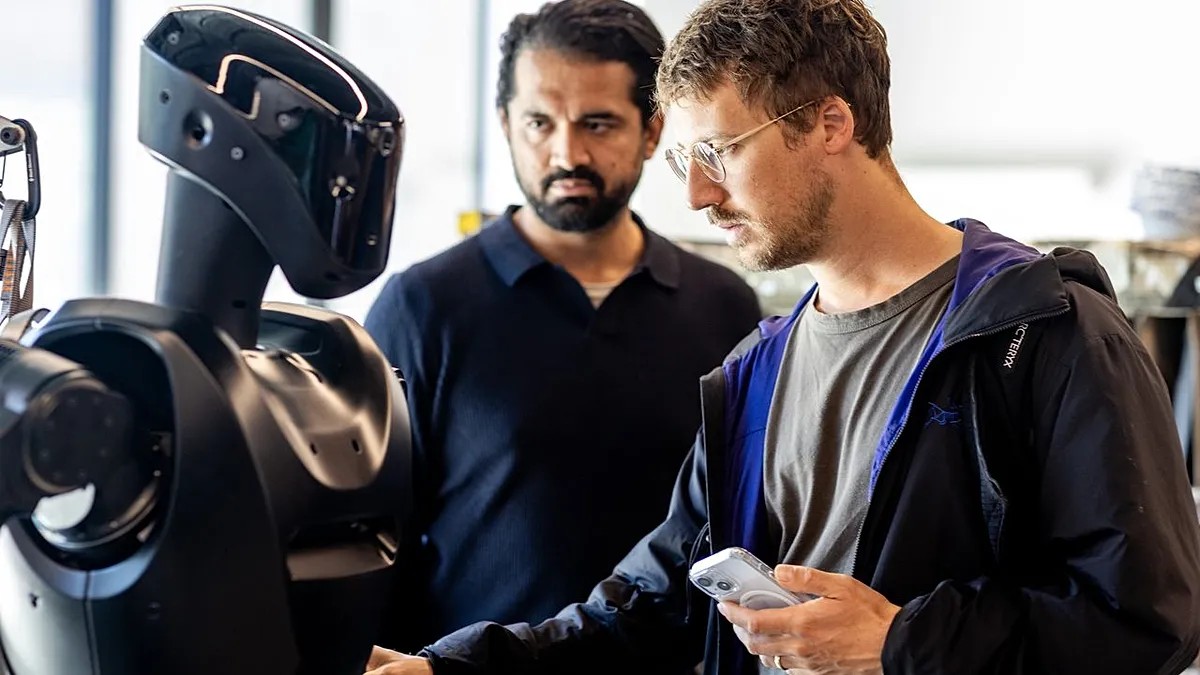
Foundation Future Industries is already testing its Phantom robots in Ukraine. Based in the US, they build humanoids for both commercial and military markets. The plan? Move to weaponized use cases by next year. At least that is what the CEO claims.
Sankaet Pathak doesn’t see this as The Terminator. Not really.
“I think we have this psychological reaction… but the reality… it’s not really like that,” he told Euronews.
He argues against the chaos of humanoid legions. Why send robots to wreck havoc when a bomb does it cheaper? It doesn’t make sense. Instead he points to precision. Avoid civilian harm. Spare infrastructure. Do the complex jobs that aerial bombing simply cannot.
Ground warfare gets uglier
Pathak doesn’t expect humanoids to replace drones. He sees them filling a hole. Ground combat is getting dangerous. Too dangerous for humans.
Humanoids only make sense when your mission is about precision… ensuring you don’t hurt civilians or destroy buildings while executing complex objectives.
It’s the next phase of precision warfare. Generally good he thinks. Though maybe not for everyone.
There are no specific treaties for these robots yet. They fall under existing International Humanitarian Law. Distinction between combatant and civilian. That rule still stands. Or tries to.
UN Secretary-General Antonio Guterres is worried. Specifically about lethal autonomous weapons. He called them “Killer robots” on LinkedIn recently.
Machines choosing targets. Taking life. No human in the loop.
The UN has been negotiating a treaty on Lethal Autonomous Weapon Systems (LAWS) since 2023. The goal is a binding ban by 2026 on systems without human control. Guterres wants it.
Pathak? He isn’t fazed.
Why treat humanoids differently than armed drones or unmanned ground vehicles? They already exist.
AI predicts the physical world
These robots run on proprietary world models. Suppliers remain undisclosed.
Forget chatbots predicting text. These systems build representations of space. They learn from video. Simulation data. They model how objects move over time. Predicting what happens next.
We are heavily focused on world models… that is going to be the core of intuitive robust AI.
Would AI seize control of the robots? Pathak says no. He thinks a rogue AI would skip the bipeds entirely. It would use drones. Or nuclear arsenals. Destroying humanity doesn’t require 100,002 walking metal suits.
The real danger he sees is AI terrorism. Cyberattacks. Disinformation. Hacking consumer drones with open source tools.
Meta’s Llama 2 launched in 2023. Uncensored versions followed days later. People asked how to build nuclear bombs. The model answered.
Pathak admits open source models pose risks to safety. Anyone can tweak them. Remove safeguards. But total loss of control? Self-replication without massive compute? We aren’t there.
“We’re probably three four maybe five hops away,” he says.
Close? Maybe. Immediate? No.
Phantom gets tougher
Even unarmed these bots have a purpose.
Material handling. Moving supplies inside and out. Reconnaissance. Clearing buildings. Mapping interiors. These tests happened in Ukraine.
The war environment forced a redesign. Harder. Denser.
Enter Phantom 2.
- Waterproof and dustproof
- Payload capacity jumps to roughly 80 kg (up from 25–30)
- Fall tolerance hits nearly 100 Gs (was 12–15)
- Powered by a 3-kilowatt-hour battery
The investor list includes Eric Trump. Stripe. Define Ventures. Others too.
Price tags are steep. Military buyers pay roughly what commercial users lease. About $100,000 per robot annually.
That’s the cost of the future arriving early.
Does precision matter when the infrastructure is gone?
If the mission is precision… avoiding damage to infrastructure.