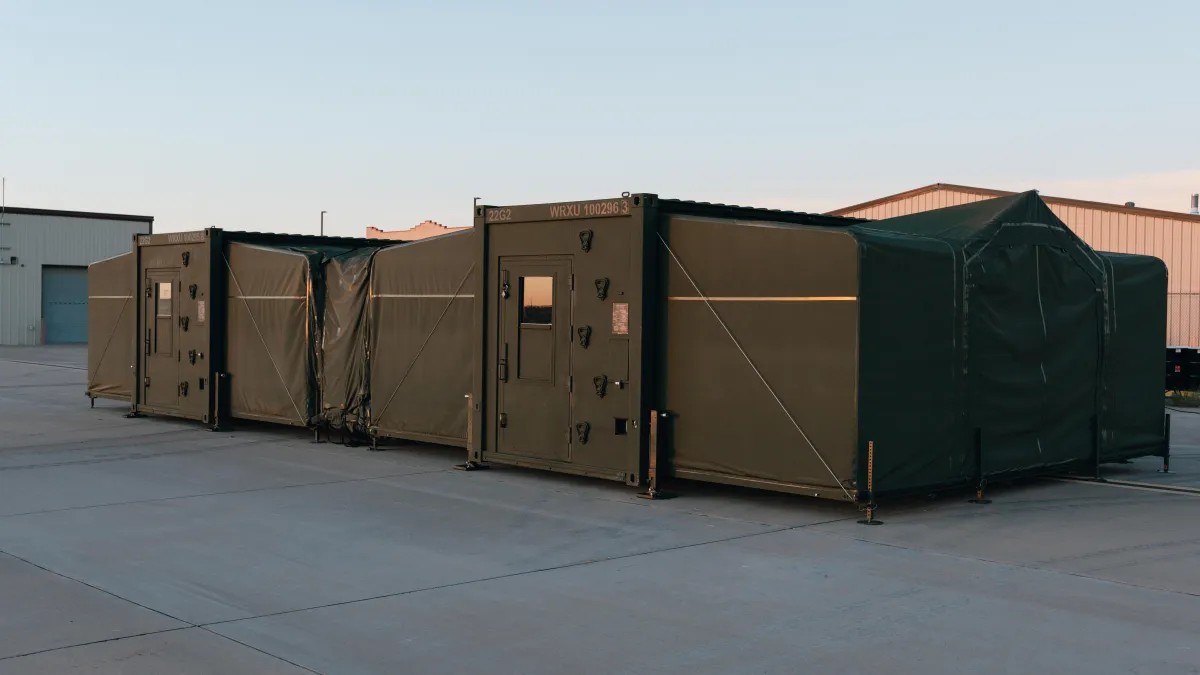
Defense startup Firestorm Labs has announced a successful $82 million Series B funding round, bringing its total capital raised to $153 million. Led by Washington Harbour Partners, the investment includes participation from heavyweights such as Lockheed Martin, In-Q-Tel, and Booz Allen Ventures.
The funding marks a critical milestone for a company transitioning from a traditional drone manufacturer to a provider of mobile, containerized manufacturing solutions.
Solving the “Contested Logistics” Problem
The core mission of Firestorm Labs is to solve a massive vulnerability in modern warfare: the tyranny of distance.
In potential high-intensity conflicts, such as those in the Indo-Pacific, traditional supply chains are a liability. When the nearest drone factory is thousands of miles away, the ships and planes required to transport parts and finished goods become easy targets for enemy interception. This challenge is known in military circles as “contested logistics” —the difficulty of maintaining a steady flow of supplies while under direct attack.
To counter this, Firestorm has developed xCell, a manufacturing platform housed entirely within a shipping container. This allows military forces to print drone systems locally, reducing reliance on vulnerable long-distance supply lines.
How the xCell Platform Works
The xCell system is designed for speed and versatility. Rather than producing a single type of drone, the platform allows for rapid reconfiguration based on the immediate needs of the mission.
- Rapid Production: The system can print a drone system in under 24 hours.
- Versatility: Drones can be configured for various roles, including surveillance, electronic warfare, or lethal operations.
- 3D Printing Integration: Each unit utilizes industrial-grade HP 3D printers to produce the drone’s body and shell. (Note: The actual weapons/munitions are not 3D-printed but are added separately).
- Beyond Drones: The technology’s utility extends to general maintenance; the U.S. Army has already used xCell to print replacement parts for Bradley Fighting Vehicles on-site, bypassing months of procurement delays.
Lessons from Modern Conflict
The pivot toward mobile manufacturing is driven by hard-won lessons from recent conflicts, most notably in Ukraine. Firestorm Labs identifies two primary drivers for this shift:
- Fixed Targets: Large, stationary factories are easy to track and destroy. Mobile, containerized units are much harder to target.
- Rapid Iteration: In modern electronic warfare, drone designs can become obsolete in weeks or even days. A mobile factory allows soldiers to update their hardware designs almost instantly to counter new enemy threats.
Current Deployment and Future Outlook
Firestorm Labs is already integrated into the U.S. military ecosystem. The company holds a contract with the Air Force with a $100 million ceiling, and its technology is currently being utilized by the Air Force Research Laboratory and Air Force Special Operations Command.
While the company has not disclosed specific locations, it has confirmed that xCell units are already operational in the Indo-Pacific region. The company’s goal is to achieve full operational deployment in that theater within the next two years.
Summary: By moving manufacturing from distant factories to the tactical edge, Firestorm Labs is attempting to turn logistics from a military vulnerability into a strategic advantage through rapid, localized 3D printing.