Most coffee shops are built on a lie. You walk in, order a nonfat vanilla latte with whipped cream, and watch the barista perform a delicate dance of steaming milk and pulling espresso shots. Meanwhile, the drip coffee machine in the back is sitting there, forgotten. It’s functional. It costs about a dollar a cup. It keeps you alive until noon. But let’s be honest, it’s boring.
One machine decided to fix that boredom. It’s called the Clover coffee maker.
Developed in 2005 by the Seattle-based Coffee Equipment Company, the Clover wasn’t designed to churn out fifty cups for the morning rush. It was built to brew one cup at a time. This shift changed everything. Instead of dumping a pot of batch brew into a thermos, baristas could tweak water temperature and brewing time for each specific drink. The result? Coffee that didn’t need milk or sugar to hide its flaws.
This wasn’t instant coffee. This was high-end, single-origin beans that could cost nearly a hundred dollars a pound. Suddenly, coffee drinkers started using words like “earthy,” “citrusy,” and “spicy.” Connoisseurs talked about floral undertones or grassy notes. Café owners realized people were willing to pay latte prices for drip coffee.
Then came the big twist. In 2006, only about 100 Clovers sold to independent shops. Sales tripled in 2007. If you lived in the right place, finding one was like hunting for a four-leaf clover. But in March 2008, Starbucks bought the Coffee Equipment Company. From then on, every Clover would appear exclusively in Starbucks locations.
What does this acquisition mean for the coffee industry? Does the Clover actually produce better coffee? And would you pay five bucks for it? We’re about to look inside the machine to see what makes it tick.
Clover Coffee: Building on French Presses and Vacuum Pots
Your daily cup of coffee is defined by two main variables: how the beans were roasted and how you prepare them. Roasting locks in the flavor potential. Grinding and brewing unlock it. The Clover machine gives you direct control over the two biggest brewing factors: water temperature and dwell time. Dwell time is simply how long the grounds sit in the water.
Precise Temperature Control with PID
The Clover uses a proportional integral derivative (PID) controller. This tech ensures the water hits the exact right temperature every single time. Temperature matters more than you might think. A difference of just a few degrees changes the outcome. Too hot, and you overextract the beans. The result is bitter sludge. Too cool, and you underextract. The cup tastes weak and hollow.
You need precision. The machine delivers it.
Dwell Time and Extraction
Beyond heat, the Clover lets you set the exact number of seconds for contact between grounds and water. The design maximizes flavor extraction. It avoids the pitfalls of other methods. It borrows the best parts of the two most popular manual brewing techniques.
Why Standard Drip Coffee Fails
Most kitchens have an automatic drip coffee maker. They are fast. They are easy. They do not taste good. These machines fail to heat the water sufficiently. They also fail to allow grounds to interact with water long enough. You get a mediocre cup because the mechanics are limited.
Manual Methods: French Press and Vacuum Pots
To get high-quality coffee, experts recommend manual methods. Specifically, a French press or a vacuum brewer. Both offer superior control over temperature and brewing dynamics.
The French Press
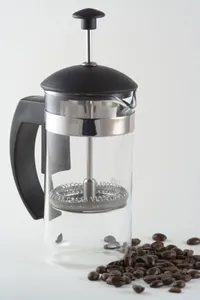
In a French press, grounds steep in almost-boiling water for several minutes. A plunger with a mesh filter sits at the top. You push it down. The screen separates the liquid from the grounds. The grounds are pushed to the bottom. You pour the coffee from the top.
Vacuum Pot Brewing
Vacuum pots use air pressure to move water. The name comes from the vacuum created between two connected globes. Heat is applied to the bottom globe. The water warms and expands. Water vapor creates pressure. This forces water into the top globe where the grounds sit. Vapor also rises to heat the water and agitate the coffee. Once heat is removed, the vacuum pulls the brewed coffee back down through a filter. Used grounds stay in the top globe.
Clover’s VacuumPress Technology
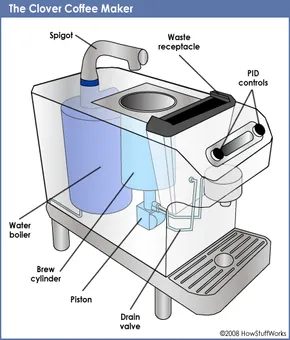
The Clover combines these methods using VacuumPress Technology. It works inside a steel brew cylinder mounted on a piston. Here is the sequence:
- The piston starts at its lowest position.
- A drain valve at the bottom closes.
- Coffee steeps normally.
- An actuator forces the piston upward.
- A perforated mesh screen holds the used grounds.
- This action mirrors a French press but in reverse.
The rising piston creates a vacuum while the drain valve stays closed. This vacuum draws the brewed coffee downward. The piston then descends. The drain valve opens. Coffee flows into your waiting cup.
What else goes into brewing Clover coffee next.
Don’t let the industrial look fool you. The Clover isn’t just a chaotic mess of pistons and valves. It’s a sleek, almost hypnotic machine that turns coffee brewing into a performance. Sure, it boasts VacuumPress Technology and PID controllers, but it still demands a skilled hand. You can’t just press a button and walk away.
Let’s trace the path of a cup.
We aren’t using pre-ground sludge here. A customer walks in, sees a menu of whole beans, and asks for an 8-ounce pour. Maybe they pick Kenyan beans. Maybe they don’t know why they picked them, but the barista does. The barista consults a tip sheet—calibrated by Clover and the specific café—to find the optimal settings for that bean.
This is where how to brew with Clover becomes a science.
The front panel has a simple dial. The barista twists it to set the volume, the brew time, and the water temperature. Precision matters. If you dial in the wrong temperature, the chemistry fails.
The Grind and the Dose
Next comes the dose. The barista weighs the beans. Then, they grind them.
This is the first point of failure. A cheap grinder can shred the beans unevenly. A distracted barista can dose incorrectly. If the grind size is off, the extraction is off. Fine grinds extract faster. Coarse grinds drag. It depends entirely on how long the water will be in contact with the grounds.
The grounds drop into the brew chamber. This is a filter sitting atop a piston. Water from the boiler behind the unit pours in. The barista stirs.
Yes, stirring.
Coffee forums are filled with wars over this step. How do you stir? How deep do you go? The goal is simple: saturate every particle. Dry clumps mean uneven extraction. Wet grounds mean consistent flavor.
The Extraction Window
Then, the machine takes over.
From the outside, you just see the coffee level bubbling up and down. Inside, the physics are complex. Pistons rise. Grounds are pushed. Valves open. It’s a violent, rapid cycle that lasts about 40 seconds.
When it’s done, a “cake” of wet grounds sits at the top. The barista wipes it out. Done.
Compare this to a French press. Or a vacuum siphon. Those are messy. They are slow. They are prone to human error in cleanup and timing. The Clover eliminates the variables.
Once you learn the settings for your favorite bean, you can replicate that cup. Every time. No more guessing if the water was too hot. No more wondering if you steeped it too long. The machine enforces the parameters.
But why does precision matter for taste?
Why does a Kenyan bean need different settings than a Sumatran one? The beans have different structures, densities, and flavor profiles. A one-size-fits-all approach leaves flavor on the table.
We are getting into the sensory side of things. What exactly are you tasting when you pull the lever? And how does the bean origin dictate the chemistry in the cup?
Tasting Clover Coffee

Clover promises to brew the perfect cup. But why does that matter when your primary goal is just waking up? Consider this: coffee beans possess more than 800 distinct flavor characteristics. Red wine has only 400. You would think that complexity warrants more than just chugging caffeine for a buzz. Clover’s technology aims to bring out those subtle notes, potentially elevating coffee to a gourmet status comparable to wine.
The science of taste hinges on two main pillars: acidity and body.
Acidity prevents the brew from tasting flat, bitter, or sour. It’s that “brightness” that makes your tongue tingle. Body describes the texture—the weight of the coffee in your mouth. There’s often an inverse relationship here; higher acidity usually means lower body. You also evaluate the aroma and the finish, those lingering notes after the last sip.
Flavor doesn’t appear by magic. It’s locked inside the bean, released by heat. Roasting happens at high temperatures for set durations. Longer, hotter processes create darker roasts. The heat caramelizes sugars and releases oils. Medium roasts generally capture the maximum flavor profile. Dark roasts can burn off those nuanced notes, leaving behind bitterness if overdone.
If you buy coffee at a major chain like Starbucks, you are likely drinking a dark roast. Clover enthusiasts argue that this machine could shift the culture toward light and medium roasts. These lighter profiles offer more nuance. Brewing extracts the oils from the grounds. The Clover gives the operator control over three critical variables: water amount, water temperature, and dwell time.
These controls are what drive the flavor profile.
But let’s be clear. The Clover cannot fix bad coffee. It doesn’t turn garbage into gold. It helps baristas pull out the flavor that is already present. Baristas still have to measure the beans correctly and grind them to the precise size. We are still learning what can be extracted from a bean. The Clover just gives us the tools to get there.
This machine has created a new breed of mad scientists. They’ve swapped test tubes for coffee cups and body parts for arabica beans. They aren’t trying to reanimate the dead. They are hunting for the ultimate brew. Tinkering with temperature or stirring patterns differently might yield the perfect cup. Once you find it, the Clover’s controls let you lock those settings in. Consistency becomes possible.
Is this worth it for your kitchen?
There is a catch. The Clover retail price sits at $11,000.
Before you write a check, look at what you are getting in terms of flavor profiles from around the globe. Understanding these distinctions helps justify the cost for serious enthusiasts.
- African coffees tend to have high acidity. Think citrusy, sweet, and floral notes.
- South Asian coffees offer a fuller body. They are smooth, rich, and earthy. Often spicier than their African counterparts.
- Latin American coffees sit in the middle regarding acidity and body. Expect fruit, nut, vanilla, or earthy undertones.
sources: Merchants of Green Coffee, Gresham
The market for these expensive machines remains niche. But for those who view coffee as more than just a caffeine delivery system, the precision might be worth the premium.

The Economics of the $11,000 Coffee
A few years back, hundreds of these machines ended up in cafes globally. It was a specific moment in time.
Consider the math. A typical café spends roughly $50,000 on equipment. About a quarter of that is for the espresso machine. Standard commercial brewers cost between $1,000 and $4,000. The built-to-order Clover? $11,000.
Does it make financial sense?
Clover’s website had a calculator for this exact problem. It weighed factors like charging a premium per cup. It calculated savings from reduced waste since the machine only brewed what was ordered. It even factored in whole bean sales. Customers could taste the quality before buying a bag.
The company claimed every location that raised prices succeeded. Why? Customers noticed the freshness. They noticed the flavor.
Pricing varied by market. In Pittsburgh, twelve ounces ran from $2.30 to $4.80. In Canada, Smiling Goat Organic Espresso Bar gained notoriety for charging $20 for a cup. Those beans were Panama Hacienda La Esmeralda. They retailed for $130 a pound in the US.
The theory was simple. Let the customer sample. They would likely buy the whole pound.
There was a downside. Brewing took about a minute longer than pouring from a carafe. That extra minute let the barista educate the customer. It allowed for upselling. But for busy downtown spots serving commuters? A minute was an eternity.
CloverNet and the Data Revolution
The hardware wasn’t the only innovation. There was also the software.
CloverNet was a web-based system. It tracked consumption in real-time. Shop owners could see which drinks were brewed. They could see who brewed them.
This data highlighted two things: popularity and performance. Which beans sold best? Which baristas were the best salespeople?
It also stored brewing profiles. If an owner perfected a specific Ethiopian blend, the system held the specs. The next time that bean was used, the settings pulled up instantly. No manual adjustments. No inconsistency.
This wasn’t just a coffee maker. It was a data collection tool.
The Seattle Connection
Starbucks was one of these customers.
The Seattle-based giant announced a deal with Clover in March 2008. The move shook the industry. It created as much buzz as caffeine itself.
You can read on to find out why that mattered.
The Home Alternative: AeroPress
Can’t bring the Clover home. Find French presses or vacuum brewers too slow?
The AeroPress exists. It draws comparisons to the Clover for taste. It uses air pressure to pull immersed grounds through a filter.
Brewing takes about 30 seconds. It makes both coffee and espresso. It retails for about $30.
It’s the closest a consumer can get to that specific pressurized experience without the $11,000 price tag.

It started with a $2.50 cup of coffee in Seattle. Early 2008. Starbucks tested the Clover machines. Regular drip? $1.55. The premium was real. And the numbers worked.
So they bought the maker. The Coffee Equipment Company. Price undisclosed. All future Clovers now live in Starbucks stores.
This wasn’t just a purchase. It was damage control.
Howard Schulz, the CEO, admitted in a 2007 memo that Starbucks had lost its “romance and theater.” The coffee felt industrial. The brand felt stale. Stock had dropped by half in the previous 15 months. They needed magic. They needed speed. They needed freshness.
Buying Clover offered all three. It arrived alongside a new flavorful blend and upgraded espresso machines. A three-pronged attack on declining relevance.
The Indie Coffee Shop Backlash
Not everyone cheered.
Independent coffee shops had adopted Clover early. They loved the control. They loved the craft. Then Starbucks bought the company.
For some, it felt like a betrayal. A sellout move. One Portland staple, Stumptown Coffee, announced it was ditching its Clovers entirely. Why? They refused to pay Starbucks for repairs.
The message was clear. You’re on your own now.
Starbucks promised to honor existing warranties. They’d provide parts. But there’s no guarantee how long that last. No further training for existing owners. Just hardware support, cold and limited.
And then there’s the data.
CloverNet. The software that tracked sales and earnings. It became Starbucks property too. By mid-May 2008, existing owners lost access. The software was pulled. Data was backed up and copied to the users. That was it. No cloud sync. No ongoing updates. Just a snapshot.
Freshness as a Weapon
Why did Starbucks do it?
Some analysts thought it was about killing independent competitors. They were wrong.
The real target was McDonald’s. And Dunkin’ Donuts.
Both chains were ramping up coffee and espresso offerings. They were threatening Starbucks’ dominance. Clover offered a solution. It brewed one cup at a time. On demand.
“Fresh coffee.”
That’s the hook. Nobody wants stale coffee. Everyone agrees on that. Starbucks could now guarantee freshness in a way mass-market competitors couldn’t. It wasn’t just about taste. It was about marketing leverage. A lock on the perception of quality.
The Romance vs. The Machine
Clover fans worry about the human element.
The machine is programmed by baristas. It requires know-how to tweak brew specs. It’s not fully automatic. It’s barista-managed.
But can that survive in a busy Starbucks?
Schulz wants romance. He wants theater. But high-volume stores prioritize speed. Will coffee scientists still have time to tinker? Or will the machine just churn out consistent, soulless cups?
The Coffee Equipment Company founders acknowledged the frustration. Early adopters were pissed. But they also saw excitement. What if every Starbucks had a Clover? What if coffee lovers finally got the premium experience they were waiting for?
It’s a gamble. Romance is hard to scale. Freshness is easy to market.
If you’re serious about coffee, keep an eye out for the Clover. It might be a luckier find than a four-leaf clover. Or it might just be another link in the chain.
The Aftermath of the Clover Era
The story of the Clover didn’t end with a bang. It ended with a acquisition. Starbucks bought the tiny Seattle maker, Aerobie, in early 2008. The move was supposed to be a victory lap. A validation of the high-tech brewing method that promised to bring home-barista precision to mass-market chains.
It didn’t work out that way.
Instead of becoming a Starbucks standard, the Clover faded. It became a niche curiosity. A relic of a brief moment where we thought coffee was just about science, not soul.
Why Starbucks Bought (and Then Let Go)
The logic was simple. If the Clover could make better coffee, Starbucks could sell more of it. They could charge premium prices for a “premium” cup.
But the machine was expensive. Complex. Fragile.
“Starbucks’ purchase takes shine off Clover.”
The Seattle Post-Intelligencer noted the irony immediately. A machine built for exclusivity was being handed to the world’s largest coffee chain. The result? A dilution of the brand’s mystique.
Starbucks tested $2.50 premium coffee to see if customers would pay up. They did. But not enough to justify the Clover’s maintenance costs. Or its size. Or its sheer weirdness.
The Human Element
People loved the machine. They wrote about it.
Corby Kummer called it “The Magic Brewing Machine” in The Atlantic Monthly. The Economist said to “Move over, espresso.”
But the magic required effort. You couldn’t just press a button. You had to understand water temperature. Pressure curves. Grind size.
“At $20 a cup, this high-end java has jolt.”
The Leader-Post reported on customers paying outrageous sums for a single cup. Was it worth it?
Some said yes. The flavor clarity was undeniable. The acidity was bright. The body was clean.
Others said no. It was pretentious. Over-engineered. Unnecessary.
Where Did It Go?
The Clover Equipment company survived, sort of. It pivoted. It stopped trying to conquer the world one cup at a time and started focusing on specific, high-end applications.
The Specialty Coffee Association of America kept talking about it. The Gourmet Coffee Zone kept reviewing its components.
But the mainstream? It moved on.
To single-serve pods. To cold brew. To the next big thing.
The Legacy of Precision
What remains is the idea that coffee can be precise. That you can control the variables.
The AeroPress, mentioned in the sources as a cheaper alternative, thrived. It borrowed the Clover’s philosophy of immersion and pressure but dropped the cost by 99%.
The Clover proved a point. It just didn’t make money doing it.
Further Reading
If you’re still curious about the science behind the brew, the sources point to deeper dives.
- Coffee Acidity: CoffeeResearch.org explains why acidity matters. It’s not a flaw. It’s a feature.
- Coffee Brewing: The same site breaks down the mechanics. Temperature control is everything.
- Coffee Tasting Terms: Coffee University offers a primer. Learn to distinguish between “body” and “aftertaste.”
- Decaffeination: How are teas and colas decaffeinated? The process matters. It affects flavor. It affects health.
The Unanswered Questions
Why did Starbucks let go?
Was it too expensive? Too slow? Too difficult for the average barista?
Or was it simply too special?
The machine sits in homes today. Collectors. Enthusiasts. People who missed the point.
They didn’t buy a coffee maker. They bought a laboratory.
And labs don’t belong in kitchens. They belong in museums.