Law enforcement and military units have long needed ways to stop suspects without killing them. They use riot shields, batons, and tear gas. But there is one tool that stands out for its ability to disable a person instantly. It is the Thomas A. Swift Electric Rifle. Most people call it a Taser.
A Taser is an electronic control device. You hold it in your hand. It shoots two tiny pins. Wires connect the pins to the unit. High voltage electricity travels through those wires. The electricity causes neuromuscular incapacitation. This is a fancy way of saying your muscles lock up. You fall down. The officer can then restrain you. It works well. It is effective.
There are problems with the standard Taser. The wires have a limit. They stretch about 35 feet. If the suspect is farther away, the Taser fails. It also takes time to reload. In a crowd control situation, you might need to fire more than one shot. Reloading a handheld device wastes precious seconds.
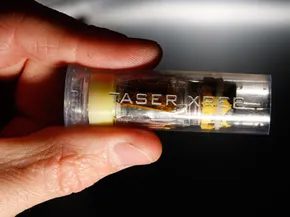
Taser saw this gap in the market. They created a new device. It is called the XREP. This stands for eXtended Range Electronic Projectile. It looks like a shotgun shell. It is designed to fit into a standard 12-gauge shotgun.
The goal was simple. Fire a non-lethal projectile from a familiar weapon. The shell contains a small Taser device inside. It delivers the same muscle-locking shock as the handheld version. But it travels much farther.
Building it was difficult. The team had to fit a powerful battery and circuitry into a tiny space. Size matters. Mass matters. If the projectile is too light, air resistance stops it. It won’t reach the target. If it is too heavy, it becomes a dangerous weapon. It could injure or kill. The engineers had to find the sweet spot.
The Taser XREP Projectile
Inside the Transparent Shell
Most officers don’t get to see the insides of their ammunition. But the XREP is different. The casing is clear plastic. Taser made it transparent so you can spot the right round before it hits the chamber. Standard shotguns use gunpowder. The XREP uses it too. It ejects just like any other shell. But what comes out isn’t lead. It’s a 3.4-gram electronic projectile. That’s roughly .12 ounces.
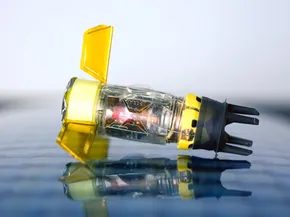
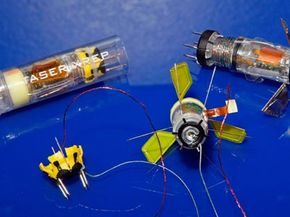
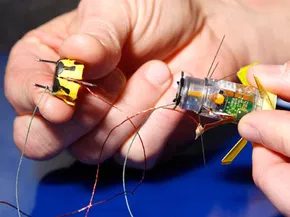
The nose carries four sharpened electrodes. They pierce through fabric and skin. They become the main contact point for the electric charge. Before it hits, the nose and the second stage move together. A pair of Kevlar-coated wires tether the two halves. This keeps the connection intact during flight.
The Electronics in the Tail
The back half of the projectile holds the brains. It contains a battery, a transformer, and a microprocessor. The microprocessor acts as both a trigger and a monitor. The battery stores the energy needed for deployment. The transformer does the heavy lifting. It converts the battery’s power into higher voltage.
How does a transformer work? It’s simple physics. Alternating current flows through coils wrapped around a core. Think of two wires coiled around an iron nail. The first coil creates a magnetic field. That field induces an electric field in the second coil. Electrons start moving. Step-up transformers increase voltage. Step-down transformers decrease it. The XREP needs a step-up. It has to generate enough voltage to induce Neuromuscular Incapacitation (NMI) in the target. Too little voltage, and the subject isn’t stopped. Too much, and you might kill them.
Safety by Design
Taser prevents the XREP from becoming a lethal weapon by limiting current. The system restricts flow to just a few milliamps. This is the key difference between a shock and a death. Amperage is the number of electrons moving. Voltage is the pressure pushing them. You can survive high voltage if the amperage is low. But 100 milliamps is all it takes to stop a heartbeat. The XREP stays below that threshold.
Deployment Dynamics
The base of the projectile holds six electrodes. They unfold upon impact. To keep the round steady in the air, three spring-loaded fins deploy when it leaves the barrel. Stabilization matters. A wobbly projectile misses.
Let’s look at the mechanics of firing the Taser XREP. The physics are precise. The engineering is brutal. But the outcome is binary. Did it work? Or did it fail?
The Anatomy of an XREP Impact
The moment those shotguns coughed, the situation shifted from chaos to a very specific, violent physics lesson. Guards weren’t just aiming; they were deploying a complex piece of hardware designed to short-circuit human will without stopping a heart.
When that XREP shell leaves the barrel, it’s not just flying. It’s transforming. A small charge inside the shell pushes the projectile forward. A ripcord snaps taut and breaks, kicking off a 20-second window of high-voltage chaos. As it clears the muzzle, spring-loaded fins unfurl. They spin the thing. Stabilize it. Even if the officer is using a smooth-bore shotgun—cheap, common, and lacking rifling—the fins force it to gyroscopically stabilize. It’s a self-correcting missile.
Then it hits.
How the XREP Works: Fracture Pins and Cholla Electrodes
Impact is the trigger. The four electrodes on the nose punch through clothing and skin. But the real magic happens inside the casing. The force of the hit breaks a series of fracture pins. These pins are the structural glue holding the nose to the base of the projectile. Once they shatter, the base swings free.
It doesn’t detach. Not yet. It hangs there by two Kevlar-coated wires.
And then the base drops.
As it falls, six Cholla electrodes unfold. They’re named after the cactus because they look like its barbed spines. If those spines catch on fabric or skin, the microprocessor inside takes over. It channels electricity through both the nose electrodes and the newly exposed Cholla electrodes. This spreads the Neuromuscular Incapacitation (NMI) effect across a wider surface area of the subject. It’s not a pinpoint zap. It’s a wide-area overload.
Most people instinctively reach for the site of a blunt impact. With an XREP, that reflex becomes a trap.
If a subject’s hand touches the reflex engagement electrodes while reacting to the hit, the microprocessor diverts the current. It creates a circuit through the arm. Electricity flows into the body, out through the hand. The effect spreads further up the limb.
But if the only contact is the nose? The microprocessor dumps all pulses through those four electrodes. Smaller area. Tighter effect.
Why Non-Lthal Force Matters in Prison Riots
The 20 seconds of voltage isn’t just about pain. It’s about time. It gives the officer the window to close the distance, to tackle, to handcuff, to restrain. The shotgun form factor is critical here. It’s familiar. It’s loaded by the dozen. If the first target is down, the guard can chamber a second round and fire at another rioter immediately. No reloading fumbling. No switching weapons. Just fire, move, fire.
Physiologically, this isn’t just shock. It’s incapacitation. The electrical signals override the body’s own motor control. Muscles lock. Balance fails. The brain can’t send the right orders. It’s a forced system reboot.
It’s not clean. It’s not gentle. But in a riot where inmates are turning on each other and the guards are outnumbered, it’s the difference between going home and covering a colleague’s body.
The fins spin. The pins break. The Cholla unfolds. And for 20 seconds, the subject belongs to the device.
The effectiveness of a Taser doesn’t come from brute force. It comes from hacking the human nervous system. It works on massive, muscular individuals just as easily as it does on smaller frames. The secret lies in muscle physiology and how your body translates brain commands into physical movement.
How Neural Signaling Controls Movement
Your body relies on a mix of electrical and chemical signals to communicate between the brain and muscles. When you decide to flex a bicep, your brain sends an electrical impulse to specific nerve cells. These cells act as transducers, converting that electrical energy into a chemical signal. That signal is a neurotransmitter.
This neurotransmitter triggers muscle cells to release calcium. The calcium binds to a protein called troponin, which regulates contraction. Muscle cells work in massive numbers, allowing for coordinated movement like lifting a finger. When the command stops, calcium returns to the sarcoplasmic reticulum, and the muscle relaxes.
Overloading the Communication System
A Taser disrupts this delicate process. It applies a high-voltage, low-amperage charge that overloads the muscle’s communication system. The electric pulses force affected muscles to contract up to 19 times per second.
Normally, the body moves by relaxing one muscle group while contracting another. An electronic pulse bypasses the brain’s commands entirely. Both sets of muscles may try to contract simultaneously. The stronger muscles usually win out, but the result is the same. You lose conscious control.
“Because the pulses override the commands from your brain, you have no conscious ability to control their movements.”
The affected area tenses up. Surrounding muscles contract. This often causes a sudden loss of balance. If you are hit in the legs, you might fall hard. Without the ability to break your fall, superficial cuts, bumps, and bruises are common secondary injuries.
The Safety Debate and Legal Reckoning
Taser International maintains that low-amperage currents pose little risk of electric burns or serious physiological damage. Critics disagree. The debate isn’t just theoretical. It has landed in courtrooms.
For years, the company avoided liability. They won every case or settled out of court. That changed in California in June 2008. A jury found Taser liable for the death of Robert C. Heston.
Heston was struck multiple times by police officers in 2005 while being subdued. The jury concluded the Taser strikes contributed directly to his death. Taser plans to appeal the decision. It was their first major loss.
Controversy in Law Enforcement
The legal setback doesn’t diminish the tool’s utility. Many officers rely on Tasers for situations where lethal force is inappropriate. The adoption of advanced systems like the XREP in military and police arsenals suggests more controversy ahead.
The technology works. The physiology is clear. The legal implications are still unfolding. What’s certain is that the debate over these devices will remain contentious. The results will keep shocking people, both in the courtroom and in the field.
To dig deeper into the mechanics of these devices, check the links on the next page.
How the Taser Shotgun Shell Works: Author’s Note

I have a complicated relationship with CES in Las Vegas. Every January, I oscillate between genuine excitement and sheer dread. The dread is rooted in the sheer scale of it. The Las Vegas Convention Center alone is a 3.2-million-square-foot beast. That is nearly 300,000 square meters of concrete and carpet. And that is just the beginning. Exhibition space bleeds into neighboring mega-hotels, creating a sprawling labyrinth of silicon and hype.
Despite the exhaustion, I always find something. Something that stops me in my tracks.
This year, it was the Taser Shotgun Shell.
It is fascinating technology. It is also absolutely terrifying. Shooting someone with an electrified slug sounds like bad science fiction. It isn’t. It is reality. The stopping power is impressive. It is legitimately scary. The invention left such a huge impression on me that I have sought out the Taser booth every year since.
How the Taser XREP Works
The device goes by a mouthful of an official name: the eXtended Range Electronic Projectile (XREP). It functions through neuromuscular incapacitation (NMI). That is the key phrase. You need to understand the mechanics to grasp why it works.
Our muscles rely on electrochemical signals. These signals race from our nervous system to our fibers. Millions of them pass through our bodies every second. It is a delicate, high-speed communication network.
A Taser breaks that network.
It introduces low-amperage, high-voltage electricity directly into that system. The overload causes the muscles to contract uncontrollably. The frequency hits up to 19 times per second. Your body simply stops obeying your brain. It locks up.
“A hit from a Taser can cause your muscles to contract up to 19 times per second.”
The Safety Debate
The stated purpose of the Taser Shotgun Shell is clear. It aims to incapacitate the target. It avoids causing severe physical injury. It is designed as a less-lethal option for law enforcement.
But “less-lethal” does not mean risk-free.
There have been reports of deaths following Taser exposure. These are not rare anomalies. They are documented occurrences. Taser, the manufacturer, disputes these claims. They argue that their products are safe when used under normal circumstances. It is a stark contrast. On one side, scientific data suggesting safety. On the other, tragic real-world outcomes.
This tension defines the product. It is a tool of immense power. It demands a nuanced view. We cannot ignore the potential for harm. We cannot ignore the utility either.
Why This Matters for You
You might think this technology is niche. It is not. Police departments are adopting it. It extends the range of a traditional Taser. A handheld unit might only reach 15 feet. The XREP fires from a shotgun-like launcher. That changes the distance. That changes the dynamic of a confrontation.
For the everyday user, it raises questions about privacy and safety. It raises questions about accountability. Who is responsible when the “safe” tool causes harm?
The Taser Shotgun Shell is not just a gadget. It is a shift in how force is applied. It is a shift in how we perceive safety.
The Bigger Picture
I keep going back to the booth. Not just for the tech. But for the implications.
The neuromuscular incapacitation technology is evolving. Patents for sub-lethal wireless projectiles continue to be filed. The science of electricity and the human body is being mapped in new ways.
We are entering an era where non-lethal force is more precise. And more dangerous.
The future of public safety is being written in voltage. And it is not always clean.