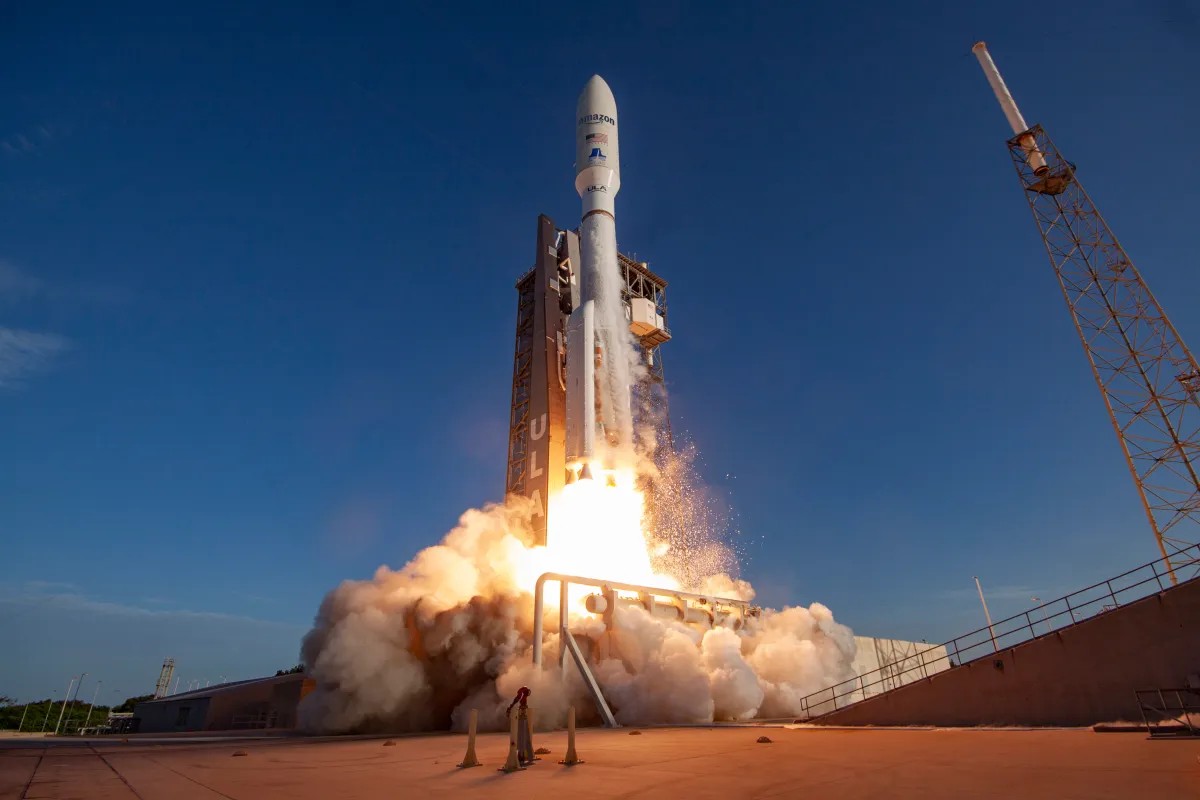
Amazon is making a serious play to break SpaceX’s hold on the sky. The tech giant filed a request with the Federal Communications Commission (FCC) to deploy a constellation of 5,105 low-Earth orbit (LEO) satellites. These aren’t just for web browsing. They are designed specifically to provide direct-to-cell service. The first launches are tentatively scheduled for 2028.
This isn’t a random experiment. It follows Amazon’s acquisition of Globalstar’s satellite operations just a few months ago. Globalstar is already the backbone behind Apple’s Emergency SOS via satellite. By leveraging Globalstar’s licensed radio spectrum, Amazon plans to merge these emergency connectivity features with Leo, its separate broadband internet satellite network. The goal is a unified mesh of connectivity that spans from text messages to high-speed data.
The High Cost of Direct-to-Device Connectivity
SpaceX currently owns this market. Its Starlink network is the default provider for satellite-to-mobile services. But Amazon sees an opening. To defend its territory, SpaceX is spending $20 billion to buy spectrum from EchoStar. This capital expenditure is central to its strategy for expanding mobile connectivity, as detailed in its initial public offering (IPO) filings.
Amazon has its own deep pockets to counter this. The company held $255 billion in current assets as of the end of April. That kind of liquidity allows for aggressive, long-term investment in infrastructure without the immediate financial pressure SpaceX faces.
However, the technical hurdles are significant. Amazon does not own a launch fleet. It had planned to rely on Blue Origin, Jeff Bezos’ space venture, to lift its satellites into orbit. Blue Origin’s heavy-lift rocket, New Glenn, was supposed to be the workhorse. Instead, it is delayed. Following an anomaly in May that destroyed its launchpad, New Glenn has been grounded. The FCC deadline for Amazon to build out the network is slipping, forcing the company to request an extension.
Is Anyone Actually Using Satellites?
Here is the uncomfortable truth about direct-to-mobile satellite service: bandwidth is terrible. Most connections are narrow. They handle text messages and emergency pings. Video calls are a no-go.
Does anyone want this? Probably not as much as telecoms think.
Srini Gopalan, who leads international for T-Mobile, gave a brutally honest assessment during a conference in May. He noted that satellite usage on T-Mobile’s network was roughly 0.0002%. That is three zeros after the decimal point. The usage is heavily concentrated in national parks and other dead zones where cellular towers simply don’t reach. Outside of these specific pockets, adoption remains niche.
“Just to give you an example… satellite usage is 0.002% of our total network. That’s three zeros.” — Srini Gopalan, T-Mobile
The Long Game for Amazon vs. SpaceX
SpaceX benefits from vertical integration. It builds its own rockets, builds its own satellites, and operates the ground stations. Amazon lacks that launch capability right now. It has to wait for Blue Origin to sort out its technical and regulatory issues.
But capital talks. While SpaceX burns billions on spectrum and manufacturing, Amazon’s balance sheet is a fortress. The company can sustain the gap in launch infrastructure while waiting for Blue Origin to become reliable. It can outlast the technical glitches.
The race is no longer just about who can launch the most hardware. It’s about who can solve the usability problem. Most users will never need satellite data. But when they do, in an emergency or in a remote location, the connection needs to work without requiring a $30,000 specialized receiver.
Amazon has the cash to iterate. It has the Globalstar acquisition to accelerate its timeline. But it still lacks the rockets. SpaceX has the rockets but faces intense scrutiny over its massive capital requirements. The winner won’t be determined by the first launch in 2028. It will be determined by who can turn a spotty, expensive luxury into something people actually use without thinking about it.
Time will tell if Blue Origin can deliver. If it doesn’t, Amazon’s satellite ambitions might drift as far into orbit as its launch vehicle.